I thought I was pretty good at Irish research.
I took a week-long class through IGHR on Irish research last summer. (I highly recommend it.) At the start of the week, the cordinator told us that by the end of the week we would learn so much that we would want to reexamine previous research. I’m not sure I fully believed him, but boy, was I wrong. I learned about record sets I was not aware of, stratagies for research that account for Ireland’s significant record loss, and much more.
For example, The Down Survey maps database and the Books of Survey and Distribution proved especially useful in my research. Following the Cromwellian conquest of Ireland, land was surveyed from 1655 to 1658 and then divided and distributed to soldiers, adventurers, and the British government. Among those soldiers was my ancestor John Allen.

I first found John in a transcription of a Quaker marriage document for his daughter. The transcriber erred while copying the record and the place John lived was misspelled, recording it as Boalnamore House. The original document could not be found and no one I contacted had any idea of what place it could be. John was described in other Quaker records as a major in the army who sometimes held Quaker meetings in his home because it was 5 miles closer to Bandon than Castlesalem, the home of Captain William Morris.
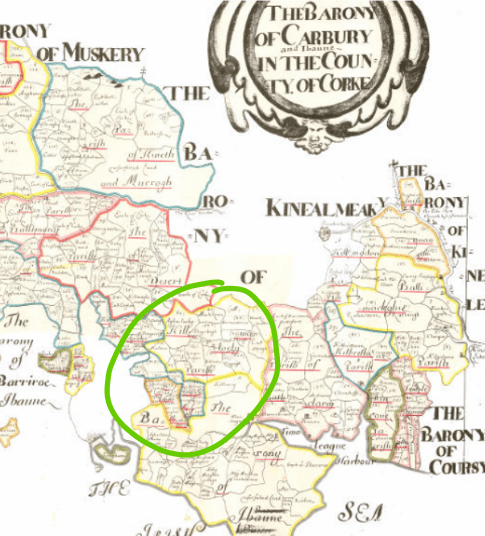
John received several tracts of land in seven townlands:
Ballyanurrogher (today Murragh and Ballinoroher)
Ballymcowen
Killcoursy
Knockastauden (today Fourcuil)
Knock Igarnaiffe (today Gorranecore)
Knocknavonnsy (today Monteen)
Madame
In the Books of Survey and Distribution, you see the name of the townland with its parish and barony, who the land was confiscated from (usually native Irish Catholics), the measurements of the land, and who was awarded the land. The Down Survey also has a collection of maps for many of the places mentioned, including John’s, and helpful descriptions of the townland that include historic and modern names.
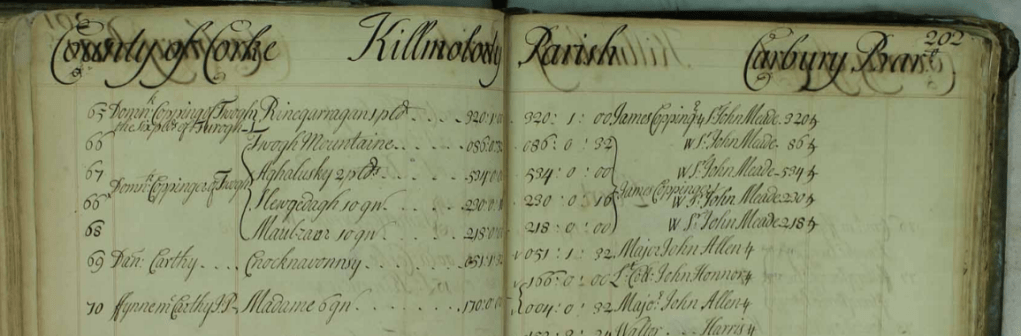
These sources gave a general idea of where John lived, but without more information, a specific place of residence could not be identified. That is until I reviewed some of my previous research…
Stay tuned for part 2.
 Heart Genealogy